Garage drywall is one of those projects that sounds optional until you learn what building code actually requires. If your garage is attached to your home, certain walls and ceilings must have fire-rated drywall installed. If it's detached, you have more freedom, but there are still good reasons to finish those walls.
We install drywall in garages across Vancouver, WA and Clark County regularly. It's one of the more common calls we get, and the questions are usually the same: Do I have to drywall my garage? What type of drywall do I need? How finished does it need to be?
This guide covers all of it: code requirements, the right materials, insulation, finish levels, common mistakes, and when to call a professional.
Do you actually need drywall in your garage?
The short answer: if the garage is attached to your house, yes. Building code requires it. If the garage is detached and freestanding, it's your choice.
The reason comes down to fire safety. An attached garage shares a wall (and sometimes a ceiling) with the living space in your home. Cars, gasoline, paint cans, lawnmower fuel, propane tanks — garages store things that burn fast and hot. Drywall on the shared surfaces creates a fire barrier that slows the spread of flame and gives your family more time to get out.
The International Residential Code (IRC), which Clark County and most Washington jurisdictions follow, specifies that the wall between an attached garage and the house must be covered with drywall to create a fire separation. The same applies to the ceiling if there is living space above the garage.
This is not optional and it is not a suggestion. It's a code requirement that gets inspected during construction and can become a problem during a home sale if it was never done or was done incorrectly.
Fire code requirements for attached garages
The IRC (Section R302.6) requires fire separation between an attached garage and the living space. Here's what that means in practice:
Shared wall between garage and house: Minimum 1/2" drywall on the garage side. Many jurisdictions, including Clark County, require or recommend 5/8" Type X on this wall for a 1-hour fire rating. Check with your local building department, because the minimum can vary.
Ceiling below living space: 5/8" Type X drywall is required when there is a habitable room directly above the garage. This is non-negotiable. A bonus room, bedroom, or office above the garage means the garage ceiling must be fire-rated.
Garage walls not shared with living space: The IRC does not require drywall on garage walls that face the exterior or a yard. However, if you are finishing the entire garage, it makes sense to do all four walls for a consistent look and to hold insulation in place.
Structural columns and support beams: If any structural members pass through the garage that support the living space above, they may need to be wrapped or protected as well, depending on the local fire code interpretation.
The purpose of all of this is straightforward: if a fire starts in the garage, the drywall buys time. A 1-hour fire-rated assembly means the wall or ceiling will maintain its structural integrity for roughly 60 minutes under standard fire test conditions. That's 60 minutes for smoke detectors to go off, for people to evacuate, and for the fire department to arrive.
Type X drywall explained
Type X is not a brand name. It's a classification defined by ASTM C1396 that describes gypsum board with enhanced fire resistance. Here's what makes it different from the standard 1/2" drywall you'd use in a bedroom:
Thickness: Type X is 5/8" thick, compared to the standard 1/2" board. That extra 1/8" of gypsum adds meaningful fire resistance.
Core composition: The gypsum core contains glass fibers that reinforce the board. When regular drywall is exposed to intense heat, the gypsum calcines (loses its water content) and the board crumbles. The glass fibers in Type X hold the calcined gypsum together longer, maintaining the barrier.
Fire rating: A single layer of 5/8" Type X on wood framing provides a 1-hour fire rating. Standard 1/2" drywall only provides about 30 minutes.
Weight: Type X boards are heavier. A 4x8 sheet of 5/8" Type X weighs about 70 to 80 pounds, compared to roughly 55 to 60 pounds for standard 1/2". This matters during installation, especially on ceilings. It's one reason garage drywall is harder to hang than it looks.
Where it goes: Type X is required on the garage-to-house shared wall (depending on jurisdiction), on the garage ceiling if there's living space above, and in other fire-rated assemblies throughout a home like furnace rooms and some party walls.
Where it's not needed: Exterior-facing garage walls, detached garages with no living space connection, and interior walls in the house that don't require a fire rating.
At the lumberyard, Type X boards are marked clearly on the edge tape or stamped on the back. They're typically available in 4x8 and 4x12 sheets. The cost premium over standard board is modest — usually $3 to $6 more per sheet — but it adds up across a full garage ceiling.
Detached garages: no code requirement, but still worth it
If your garage is a standalone structure with no physical connection to the house, building code generally does not require drywall. You could leave the studs exposed and call it done.
But there are practical reasons to drywall a detached garage anyway:
Dust and debris control. Exposed fiberglass insulation sheds fibers. Open stud bays collect dust, cobwebs, and rodent nests. Drywall seals the wall cavity and gives you a cleanable surface.
Finished appearance. If you use the garage as a workshop, gym, or hobby space, finished walls look better and make the space feel more usable.
Insulation retention. Drywall holds batt insulation in place. Without it, batts sag, fall out of the stud bays, and lose effectiveness over time.
Property value. A finished garage, even with a basic Level 2 finish, adds perceived value to a home. Buyers notice.
For a detached garage, standard 1/2" drywall is fine. You don't need Type X unless there's a specific reason (like a living space above a detached garage conversion, which would then fall under different code requirements).
Insulation in garage walls
Not every garage needs insulation, but if you're going to hang drywall anyway, it's the right time to add it. Once the drywall is up, getting insulation into the walls means tearing it all off.
When insulation makes sense:
You heat or cool the garage. If there's a space heater, mini-split, or any form of climate control, insulation is what makes that energy expenditure worthwhile. Without it, you're heating the outdoors.
You use the garage as a workshop or living-adjacent space. Woodworkers, mechanics, and hobbyists who spend hours in the garage will notice a 20-degree difference on a January morning in Vancouver, WA. Our winters hover around 35 to 40 degrees. Insulated walls keep an unheated garage closer to 45-50 degrees instead of matching the outdoor temperature exactly.
You want noise reduction. Insulation dampens sound transmission. If the garage shares a wall with a bedroom, insulating that wall reduces how much noise passes through from power tools, car doors, and garage door openers.
Common insulation types for garages:
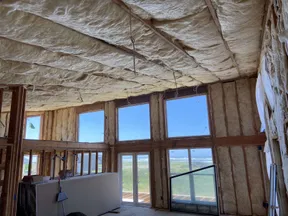
Fiberglass batts are the most popular choice. R-13 for 2x4 walls, R-21 for 2x6 walls. They're affordable, widely available, and straightforward to install before the drywall goes up. Our insulation services include fiberglass batt installation for garage projects.
Mineral wool batts (Rockwool) offer better fire resistance and sound dampening than fiberglass. They cost more per batt but are worth considering for shared walls where fire rating and noise matter.
Rigid foam board works well for garage ceilings and can be used on walls as a supplement. It adds R-value without taking up stud-bay depth.
Spray foam is the premium option. It seals air gaps completely and provides the highest R-value per inch. It's typically overkill for a standard garage unless you're converting it to conditioned living space.
Finish levels for garages
You don't need Level 5 walls in your garage. You don't even need Level 4 in most cases. The drywall finish level system gives you a range, and garages sit at the lower end.
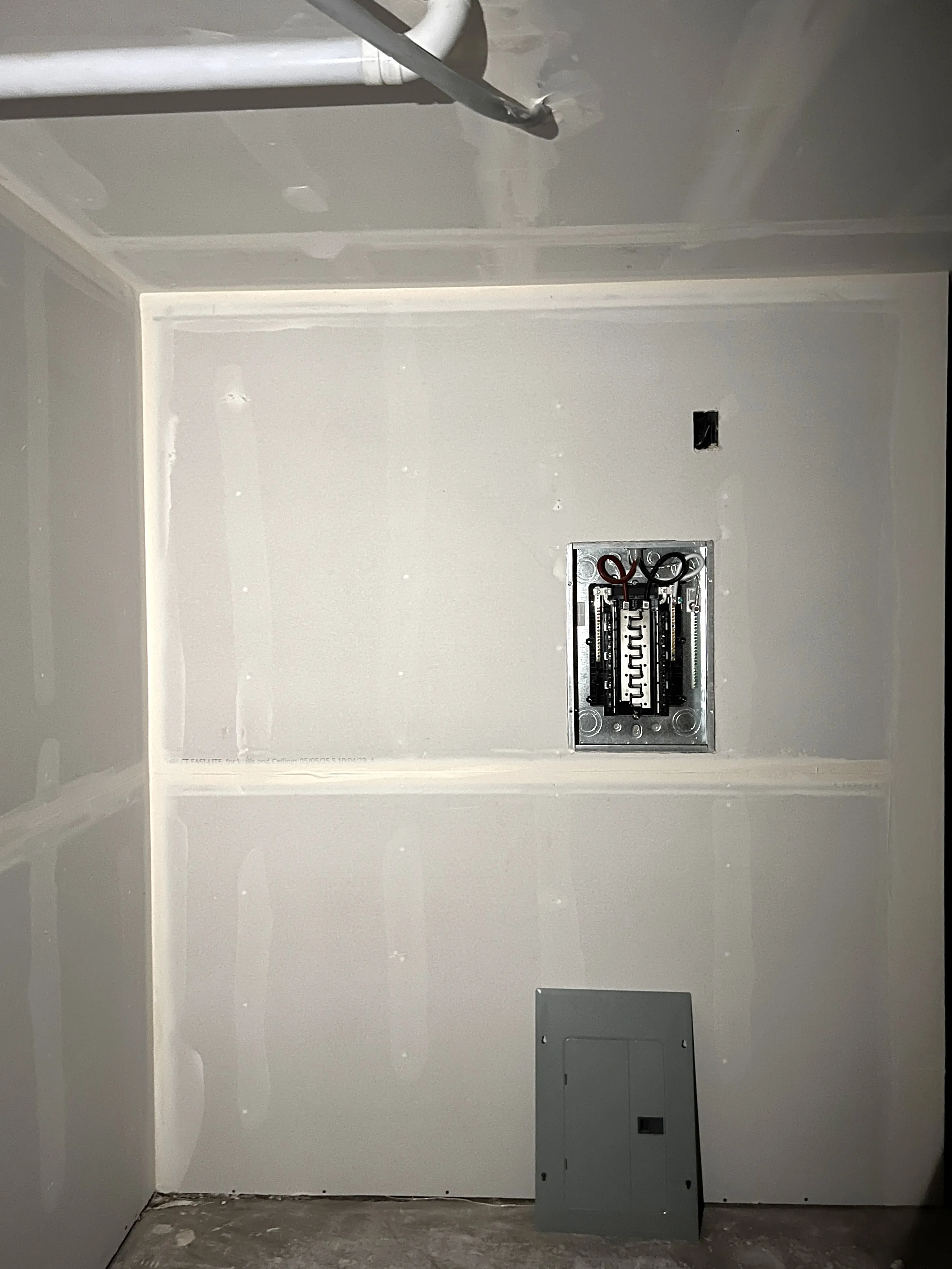
Level 1 (fire tape): Tape embedded in joint compound on the seams and angles. No second coat, no coverage on screw heads. This is the bare minimum for fire-rated walls. Meets code but looks unfinished.
Level 2 (garage standard): Tape plus a second coat on the seams, and one coat over screw heads. The surface is wiped smooth but not sanded. This is the most common finish level for garages that will not be painted. It meets code, it looks clean, and it keeps cost down. Most garages we finish in Clark County end up at Level 2.
Level 3 (texture ready): Two coats on seams, coverage on screw heads, and sanding. The surface is ready for a spray texture or paint with texture. Choose Level 3 if you want to paint the garage or apply a knockdown or orange peel texture.
Level 4 (standard residential): Three coats on seams, three on screw heads, full sanding. This is what you'd use if you're converting the garage into a living space, a home gym with bright lighting, or any space where the walls need to look as good as the rest of your house.
For most homeowners, Level 2 is the sweet spot for a garage. It's code-compliant, it looks respectable, and it keeps the budget reasonable. If you plan to paint, step up to Level 3. If you're making the garage a real room, go Level 4.
Common mistakes with garage drywall
We've seen all of these on repair calls and remodel tear-outs. Some are cosmetic issues. Others are code violations.
Using standard 1/2" drywall where Type X is required. This is the most consequential mistake. If the shared wall between your garage and house needs a fire rating, standard drywall does not meet code. An inspector will catch it during construction. During a home sale, a savvy home inspector will flag it too. The fix means tearing off the wrong board and replacing it.
Not taping the seams. Hanging drywall without taping defeats much of the fire resistance purpose. Fire follows the path of least resistance, and untaped joints are open pathways for flame and smoke. Even in a detached garage, untaped seams look bad and accumulate dust.
Skipping mud on screw heads. Every exposed screw head is a potential rust point. In a garage with temperature swings and humidity, bare screws will eventually rust and stain through paint. A single coat of compound over each screw head takes seconds and prevents this.
Not running drywall to the floor. Code requires that the drywall on fire-rated garage walls extends fully to the concrete slab. Leaving a gap at the bottom — even a few inches — compromises the fire barrier. We see this surprisingly often. The drywall should be cut to within about 1/2" of the floor, and any gap at the bottom is acceptable only if it is small enough not to compromise the fire assembly.
Forgetting the attic hatch or pull-down stairs. If there's access to the attic from the garage, the hatch or pull-down stair assembly may need to be fire-rated too. A standard plywood hatch on a fire-rated garage ceiling is a code violation.
Hanging drywall before electrical and plumbing are roughed in. This seems obvious, but we get calls from homeowners who jumped ahead. The drywall has to come off, the rough-in happens, and then the drywall goes back on. Plan the sequence correctly: frame, rough-in mechanical, insulate, then drywall.
DIY vs. hiring a professional
Garage drywall looks like a straightforward weekend project. The boards are big rectangles, the garage is usually a simple box shape, and there are plenty of YouTube tutorials. So why hire a contractor?
Weight. A 4x12 sheet of 5/8" Type X drywall weighs over 100 pounds. Hanging it on a ceiling means lifting that weight overhead and holding it in place while you drive screws. With a helper, it's strenuous. Alone, it's nearly impossible without a drywall lift, and even then it takes practice to position the sheets correctly.
Code compliance. Fire-rated assemblies have specific requirements beyond just the board type. The right screws, the right spacing (typically 12" on center for ceilings, 16" for walls), and the right taping all matter. If you're pulling a permit for the work, the inspector will check these details.
Cutting around obstacles. Garage walls have electrical panels, outlets, light switches, hose bibs, and sometimes gas lines. Every cutout needs to be accurate. A bad cut around an electrical box compromises the fire barrier.
Finishing quality. Even at Level 2, taping and mudding take skill. Poorly applied tape bubbles and peels. Uneven compound dries with ridges. These are things you notice every time you walk into the garage.
For a simple detached garage with standard 1/2" board and no fire rating requirement, a confident DIYer can handle it. For an attached garage with Type X requirements, fire-rated assemblies, and potential permit inspections, hiring a professional ensures the job meets code the first time.
At AvilaCo, we handle the full scope: insulation, drywall installation, taping, mudding, and the finish level you need. We know the Clark County code requirements and what inspectors look for. One crew, no subcontracting, and a clean job site when we leave.